


There are many raw materials for producing activated carbon, including coconut shell, fruit shell, wood, and coal. Among all these types, coconut shell activated carbon is relatively the most expensive. Its higher price is attributed to its superior adsorption performance compared with other varieties of activated carbon.
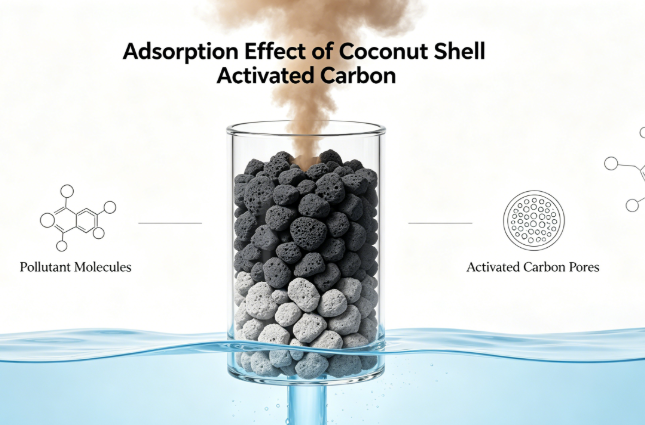
Is there any scientific basis for the better adsorption effect of coconut shell activated carbon? Under scanning electron microscopy, scientists compared the pore size distribution of coconut shell activated carbon, fruit shell activated carbon and coal-based activated carbon. The results show that coconut shell activated carbon boasts the most abundant and well-developed pore structure among them. Its pore diameter is 20,000 times that of formaldehyde molecules, while that of biological ceramic is only 500 times. According to adsorption theory, the adsorption effect is determined by the proportional relationship between pore size and the molecular size of the substances to be adsorbed. This explains the extremely strong adsorption capacity of coconut shell activated carbon.
For activated carbon, larger and more abundant pores mean better adsorption performance. For example, people are familiar with the good adsorption capacity of sponges, yet they may not know much about that of coconut shell activated carbon. A sponge has strong adsorption properties thanks to its numerous tiny pores, which can absorb water into its internal cavities. When saturated with water, its weight increases significantly, mainly due to the large specific gravity of water.
To understand the adsorption power of coconut shell activated carbon, here is a vivid analogy: If all the pore walls of 1 gram of coconut shell activated carbon were fully unfolded, they would cover an area as large as a basketball court. This perfectly accounts for its outstanding adsorption performance.


