


When you open the tap and fill a glass with crystal-clear, taste-free water, few people realize that behind this purity lies an army of "black granules" working silently in the dark-these are anthracite filter media. Acting as the front-line soldiers in multi-layer filters, they not only secure a stable effluent turbidity below 0.1 NTU but also govern the formation of later-stage disinfection by-products and the final flavor and safety of the water that reaches every household.
Only deep-well anthracite from Jincheng and Yangquan, Shanxi is selected. With a fixed-carbon content ≥ 90 %, volatile matter ≤ 6 %, and naturally low sulfur and phosphorus, it is born "clean" and free of any toxic volatiles.
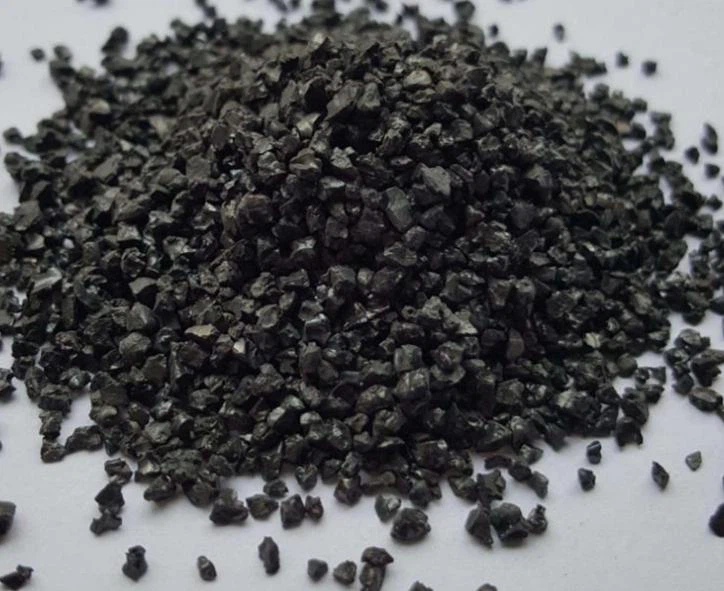
After crushing and sieving the grains become multi-angular, near-spherical particles whose rough surface and > 50 % open porosity create a huge specific area. They thus combine "surface adsorption + pore interception", removing colloids, flocs and algal cells larger than 0.5 µm at least 30 % more efficiently than quartz sand.
With a Mohs hardness of 3.5–4, the sum of crushing and abrasion loss is ≤ 3 %. Within pH 5–10 it is virtually insoluble; even after tens of thousands of high-intensity air-water backwashes every year the grain-size profile remains unchanged, giving a service life of 5–7 years-far longer than traditional sand.
Its bulk density is only 1.4 g cm⁻³, 70 % that of quartz sand. A 30 % bed expansion during backwash is enough for perfect cleaning, cutting wash-water and power consumption by 30–40 % and strongly supporting a plant's "dual-carbon" goals.
In the classic anthracite–quartz–gravel configuration (coarse-on-fine) deep-bed filtration turns 20 NTU settled water into < 1 NTU effluent in one step. A 70 cm anthracite layer alone retains > 80 % of the floc, greatly reducing the load on the underlying sand, raising filtration rates to 12–15 m h⁻¹ and boosting output by 40 %.
The rough grains host a thin biofilm that forms "dark biomass" inside the light-starved bed, performing micro-nitrification of ammonia and nitrite. This cuts subsequent chlorine demand by 10–15 % and lowers trihalomethane formation potential.
In single-village supply stations a 0.6 m deep bed of 0.5–1.2 mm refined anthracite, run at 5 m h⁻¹ slow filtration, removes Fe, Mn, F⁻ and pesticide residues on the spot, solving "last-100 m" quality problems for only one-fifth the capital cost of a membrane plant.
Although its surface area is smaller than that of activated carbon, anthracite's larger pores and lower head-loss make it an ideal pre-filter or "security filter". By intercepting most suspended matter it extends the fouling cycle of downstream GAC or UF membranes, creating a three-barrier scheme of "anthracite–activated carbon–disinfection" that saves carbon regeneration costs while keeping dissolved-organic removal above 60 %.
From Yellow-River source water to southern reservoirs, anthracite filter media-with its high strength, low water use, long life and non-toxic nature-has become an invisible yet indispensable guardian of China's drinking-water safety. Under the "dual-carbon" strategy and the new era of high-quality supply, further optimization of grain-size distribution and exploration of composite beds with novel membranes or functional ceramics will keep amplifying the clarifying power of these black granules, offering every household a still firmer, greener and more economical barrier to purity at the tap.
https://www.naturecarbon.com/anthracite-filter-media/


