


The gold-adsorbing activated carbon is produced from high-quality coconut shells as the raw material, refined through physical methods and high-temperature steam activation processes. The gold-adsorbing activated carbon features uniform particle size, high mechanical strength, and strong adsorption capacity. After further processing with special techniques such as water grinding, it exhibits excellent wear resistance and high adsorption performance. It is suitable for modern gold mining production and primarily used in heap leaching or carbon-in-pulp methods for the separation and extraction of precious metals in metallurgical industries.
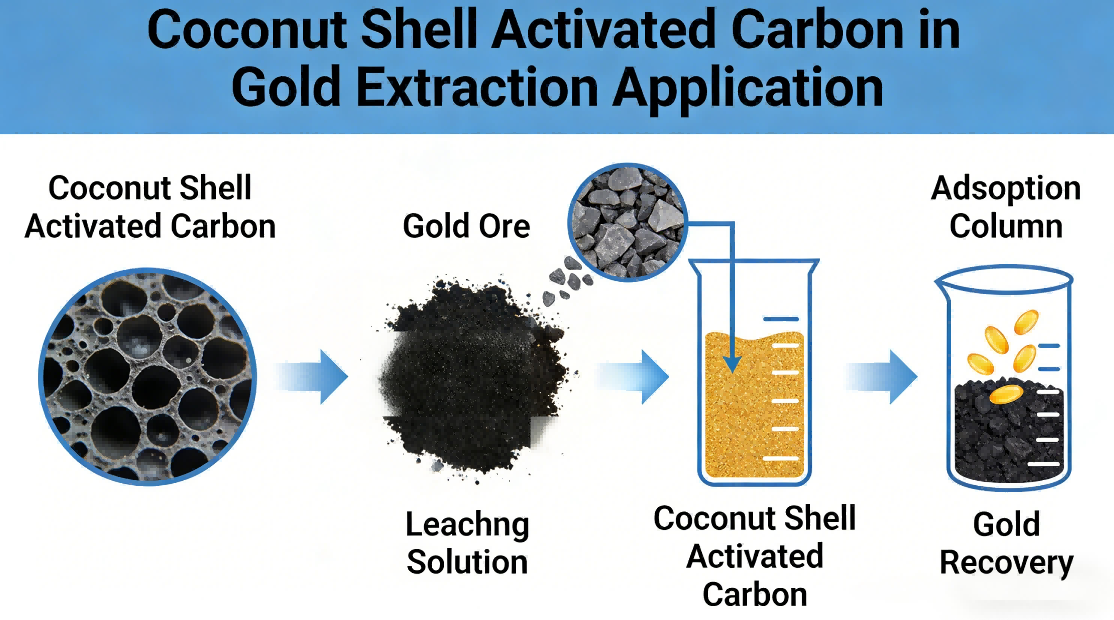
Coconut shell activated carbon is a porous carbonaceous material with a highly developed pore structure, making it an excellent adsorbent. The adsorption area per gram of activated carbon is equivalent to that of eight tennis courts. With its strong adsorption capacity, it is commonly used for gold extraction.
1. Raw Material Preparation and Ore Processing
Broken ore: First, the gold-bearing ore is mechanically crushed to an appropriate particle size (e.g., a few millimeters to several tens of millimeters) for subsequent processing and adsorption.
Prepare the slurry: Mix the crushed ore with water to form a slurry, preparing it for subsequent chemical reactions and adsorption processes.
2. Cyanide Leaching
Add cyanide: Introduce cyanide (such as potassium cyanide or sodium cyanide) into the slurry, allowing the gold to react with the cyanide and form water-soluble gold-cyanide complexes. This step is crucial for gold extraction, as it transforms the originally water-insoluble gold into a soluble and easily adsorbable form.
3. Activated Carbon Adsorption
Add coconut shell activated carbon for gold extraction: Introduce the pre-treated coconut shell activated carbon into the slurry containing cyanide-gold complexes. The coconut shell activated carbon, due to its well-developed porous structure and large specific surface area, can effectively adsorb the cyanide-gold complexes in the solution.
Thorough Mixing and Adsorption: The slurry is fully stirred in the activated carbon adsorption tank to ensure that most of the cyanide-gold complex ions are adsorbed within the pores of the activated carbon.
4. Separation and Regeneration
Separation of gold-bearing carbon: The activated carbon adsorbed with gold is separated from the slurry to form "gold-bearing carbon.".
Desorption and Regeneration: Gold is desorbed from activated carbon through specific methods (such as high-temperature roasting or using desorption solutions) to restore the adsorption capacity of the activated carbon for reuse. This step not only recovers gold but also enables the recycling of activated carbon.
5. Gold Recycling
Electrolysis or other chemical methods: Gold is recovered from desorbed solutions, typically achieved through electrolysis or other chemical processes. Electrolysis is a common technique that uses electric current to reduce metal ions in the solution into pure metal.
Precautions
Throughout the entire refining process, it is essential to strictly control conditions such as temperature and pH to ensure the smooth progress of chemical reactions and adsorption processes.
The physical properties of coconut shell activated carbon (such as porosity, density, and strength) significantly influence its adsorption performance, necessitating thorough pretreatment and selection before use.
Safety and environmental protection during the extraction process must not be overlooked, and appropriate measures must be taken to prevent the leakage and emission of hazardous substances. The coconut shell activated carbon gold extraction process is a complex and meticulous procedure involving multiple stages and technical key points. By implementing reasonable operational procedures and control conditions, the adsorption capacity of coconut shell activated carbon can be fully utilized, enhancing the efficiency and quality of gold extraction.


