


Overview of Activated Carbon Waste Gas Treatment Process
Activated carbon, as an excellent adsorbent, is produced from raw material such as charcoal, various fruit shells and high-quality coal, processing and manufacturing them through a series of physical and chemical methods such as crushing, screening, catalyst activation, rinsing, drying, and screening. Activated carbon has dual characteristics of physical adsorption and chemical adsorption, which can selectively adsorb various substances in gas and liquid phases to achieve the purposes of decolorization, purification, disinfection, deodorization, and decontamination. Activated carbon adsorption is a common waste gas treatment process. Activated carbon adsorption utilizes porous activated carbon to adsorb organic gas molecules onto its surface, thereby purifying and treating exhaust gases.
Process flow of activated carbon waste gas treatment
1.Introduction to Process Flow

2.Process Description
The organic waste gas in the factory workshop is collected through a suction hood, and then transported through a pipeline into a dry filter under the action of an exhaust fan. It then enters an activated carbon adsorption device, where organic pollutants are adsorbed by activated carbon. The purified gas is pressurized by a fan and discharged in compliance with standards.
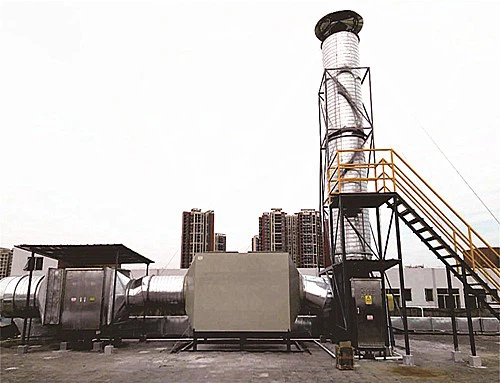
3. Adsorption principle of activated carbon
The adsorption phenomenon of activated carbon occurs at two different phase interfaces, and the adsorption process is the diffusion process at the interface, which occurs on the solid surface due to the residual attraction on the solid surface.
Adsorption can be divided into physical adsorption and chemical adsorption; Physical adsorption, also known as van der Waals adsorption, is caused by the electrostatic force or van der Waals attraction between the adsorbent and the adsorbate molecules. When the molecular attraction between solid and gas is greater than that between gas molecules, even if the gas pressure is lower than the corresponding operating temperature and saturation vapor pressure, gas molecules will condense on the solid surface. Physical adsorption is an endothermic process.
Chemical adsorption, also known as active adsorption, is caused by the chemical reaction force between the surface of the adsorbent and the adsorbate molecules. It involves the destruction and recombination of chemical bonds in the molecules. Therefore, the adsorption heat in the chemical adsorption process is greater than that in the physical adsorption process.
In the adsorption process, there is no strict boundary between physical adsorption and chemical adsorption, and the same substance is often chemically adsorbed at lower temperatures. Activated carbon fiber adsorption is mainly based on physical adsorption, but due to the presence of surfactants, there is also a certain degree of chemical adsorption.
4. Adsorption characteristics of activated carbon on exhaust gas
(1) The adsorption of aromatic compounds is superior to that of non aromatic compounds.
(2) The physical adsorption of hydrocarbons with branched bonds is superior to that of straight chain hydrocarbons.
(3) The adsorption of substances containing inorganic functional groups in organic matter is always lower than that of substances without inorganic functional groups.
(4) The adsorption of compounds with high molecular weight and boiling point is always higher than that of compounds with low molecular weight and boiling point.
(5) The higher the concentration of adsorbate, the higher the adsorption capacity.
(6) The larger the surface area of the adsorbent, the higher the adsorption capacity.
5. Application fields of activated carbon
Activated carbon is widely used in the adsorption and recovery of waste gases and solvents generated in the production processes of petrochemicals, pharmaceuticals, fine chemicals, electronic components, plastic printing, coating, film, adhesive products, high-end wax paper, fibers, plastics, artificial leather, etc., utilizing the high adsorption and desorption properties of activated carbon.


