


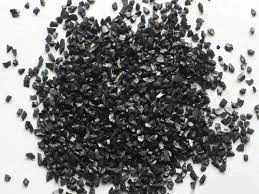
At the heart of modern water purification systems lies anthracite filter media – a granular material processed from specific grades of anthracite coal. Through crushing, sizing, and washing, this natural resource transforms into an indispensable physical filtration medium, earning its reputation as the reliable "black cornerstone" of clean water.
Core Properties: The Foundation of Performance
High Carbon Content & Stability: With fixed carbon content typically exceeding 80%, anthracite offers exceptional chemical inertness. It resists dissolution and reaction across a wide range of pH and oxidation conditions found in water treatment, preventing secondary contamination and ensuring pure filtration.
Superior Strength & Hardness: Anthracite's dense, hard structure grants it outstanding mechanical strength and abrasion resistance. It withstands vigorous hydraulic loading and repeated backwashing cycles, leading to a long operational life and reduced maintenance costs.
Optimal Specific Gravity: Its specific gravity (typically 1.4-1.8 g/cm³) is significantly lower than sand. This allows anthracite to naturally form the top layer in multi-media filters (e.g., anthracite-sand-garnet). This layered configuration maximizes dirt-holding capacity: the coarser anthracite efficiently removes larger suspended solids first, while finer sand layers below handle deeper polishing.
Beneficial Surface Structure: Anthracite grains possess a naturally irregular surface with micro-porosity. This increases surface area and enhances physical adsorption, aiding in the removal of fine colloids and some organic matter.
Favorable Surface Characteristics: Its relatively smooth and hydrophobic surface prevents trapped impurities from embedding too deeply. This allows for more efficient release during backwashing, ensuring excellent regeneration and sustained filter performance.
Key Applications: Safeguarding Water Quality
Municipal Drinking Water: A primary layer in rapid sand filters at water treatment plants, anthracite is crucial for removing turbidity, suspended solids, algae, and certain microorganisms, forming a vital barrier for safe public water supply.
Industrial Water Pretreatment: Widely used in power generation, chemical, electronics, textile, and food/beverage industries. It provides high-clarity feed water for boilers, process cooling, and production, protecting downstream equipment and enhancing product quality.
Wastewater Polishing & Reuse: Employed in tertiary filtration at wastewater treatment plants to reduce residual suspended solids (SS) and turbidity from secondary effluent, meeting stringent discharge standards or enabling water reuse (e.g., irrigation, industrial cooling).
Swimming Pool & Recreational Water: The preferred medium for pool circulation filters and systems maintaining clear water in fountains, ponds, and artificial lakes, effectively controlling algae.
Industrial Cooling Systems: Used in side-stream filters for recirculating cooling water systems to continuously remove suspended solids and biological slime, maintaining system efficiency.
Critical Quality Parameters
Quality is paramount for filtration efficacy and lifespan. Key parameters include:
Grain Size & Uniformity: Precise sizing (e.g., 0.8-1.2mm, 1.2-1.6mm) and a low uniformity coefficient (K80 ≤ 1.5-1.8) ensure optimal pore distribution, filtration accuracy, and backwash efficiency.
Specific Gravity (Density): Maintaining the typical range (1.4-1.8 g/cm³) is vital for stable layering in multi-media beds and effective backwashing.
Fixed Carbon Content: Higher is better (≥80%). It directly correlates with purity, chemical stability, and resistance to breakdown. Low carbon means higher ash content.
Ash Content: Lower is better (≤8%). High ash indicates impurities, reducing durability and increasing the risk of leaching contaminants.
Acid Solubility: Lower is better (≤3.5%). Measures stability in acidic conditions and potential for leaching, impacting treated water quality.
Abrasion & Attrition Resistance: Low values (≤2% for both wear and breakage) indicate strong mechanical integrity and longevity, minimizing fines generation that clogs filters.
Mud/Silt Content: Minimal (≤1%) is essential to prevent initial fouling and ensure efficient backwashing right from startup.
Porosity: Affects dirt-holding capacity and headloss development (typically 45-55%).
Production Process: From Raw Coal to Premium Media
Manufacturing high-quality anthracite media involves:
1. Raw Material Selection: Sourcing high-carbon, low-ash lump anthracite.
2. Crushing: Breaking raw coal into approximate size ranges.
3. Sizing: Precise screening to achieve strict size specifications and uniformity.
4. Washing: A critical step using high-pressure water to remove coal fines, silt, and soluble salts, significantly reducing ash and silt content.
5. Dewatering/Drying: Removing excess moisture for stable storage and transportation.
6. Quality Control & Packaging: Rigorous testing of final product against specifications before packaging.
Market Outlook
Driven by rising global demands for safe drinking water, environmental protection, and water reuse, the need for efficient, robust, and cost-effective filtration media remains strong. Anthracite filter media, with its proven performance – particularly its high dirt-holding capacity and excellent cleanability – combined with economic value, will continue to be a fundamental physical filtration solution. Future advancements lie in optimizing production (e.g., finer size control, enhanced washing), improving consistency, and exploring potential for enhanced removal of specific contaminants like heavy metals or phosphorus.
Conclusion
Anthracite filter media, this "black gold" refined by modern processing, stands as a vigilant guardian of water clarity. Its unique blend of chemical stability, physical resilience, ideal density, and excellent filtration capabilities makes it irreplaceable across countless applications – from municipal taps to industrial processes. As water scarcity intensifies, the reliable and economical anthracite filter media will endure as a crucial "black cornerstone," underpinning efforts to secure clean water for generations to come.
Link: https://www.naturecarbon.com/anthracite-filter-media/


